
What is Nylon Injection Molding?
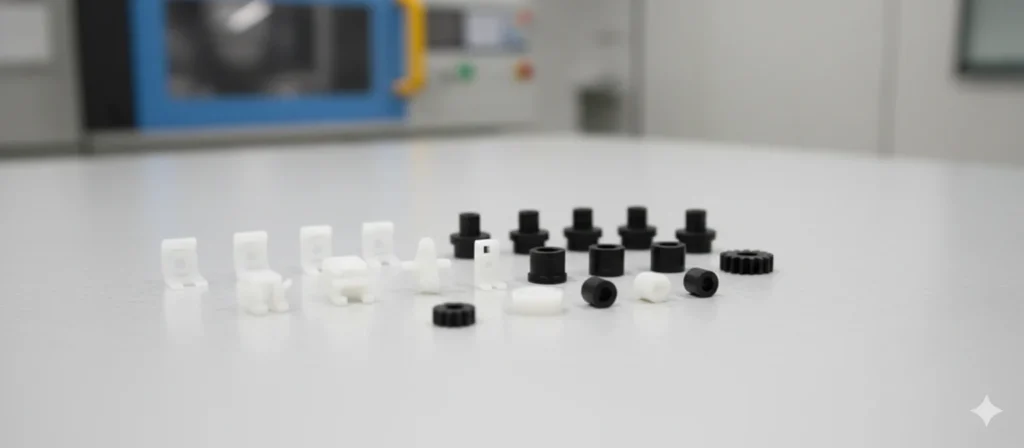
Injection molding of hygroscopic engineering resins, PA6, PA66, PA12, etc., is performed at a temperature lower than that of the resin under normal conditions, and forced into a precision steel mold after heating, to form strong, wear-resistant components -gears, bushings, clips, brackets, cable-management components, connectors, and under-hood parts. Nylon can be appreciated for its high strength, resistance to fatigue, low friction, and exemplary performance in the presence of chemicals/heat.
What are the materials used in injection molding of nylon?
- PA6 / PA66: General strength and toughness; extensive structural clips, gears, housings, and general use.
- PA12: Reduced moisture uptake, high dimensional stability; tubing, fittings and fine clips.
- Glass-fibre reinforced PA (GF-PA): Far stiffer/heater-resistant load-bearing brackets/enclosures.
- Mineral-filled PA: Excellent surface finish, better dimensional stability, and warp control.
- Impact-modified PA: Improved impact at low temperatures of clips/latches.
- MOS2-filled/lubricated PA: Reduced friction and wear on sliding parts (gears, bushings).
- Flame-retardant PA (UL options): In electrical/electronic housings and connectors.
Application Nylon injection in the industry.
Energy and Industrial Solutions:
Nylon plastic is often used as components such as connectors, insulation components, and mechanical assemblies. Honeywell (Canada), a manufacturer of temperature control systems for both industrial and residential solutions, utilises nylon molded parts in the production of its systems. These components enjoy the advantage of high temperature resistance and mechanical strength of nylon, which guarantees successful performance under adverse industrial conditions.
- Electronics and Manufacturing:
Nylon plastic is ideal for producing enclosures, circuit board holders, and electrical connectors.Nylon injection-molded parts are used in the wireless controllers by SCL Elements, a subsidiary of Schneider Electric (Montreal). The hardness and tensile strength of the material ensure the safety, efficiency, and functionality of the products provided by Schneider, even in harsh conditions such as those found in industrial control systems.
- Automotive Solutions:
Nylon plastic is also essential in the automotive industry, as it is utilised in the creation of lightweight parts, including brackets, valve covers, and engine components. APTIV (Indonesia) manufactures automotive wiring systems, utilising nylon molded parts in their sensor casings. The thermal stability and strength of the material used are crucial for shielding sensitive electronic structures in vehicles, ensuring the structure’s performance lasts even in severe environments.
Process of it
- DFM inspection: Uniform wall strategy, ribbing (40-60% of wall), draft, gate placement, and knit-line risk management.
- Material conditioning: Drying out (nylon is hygroscopic) to avoid splay/voids; the moisture window is recorded.
- Molding & packing: Optimisation of melt /mold temperatures and injection profile; successful pack/hold to stabilise dimension.
- Cooling and ejection: balanced cooling to minimise warp; controlled ejection to safeguard edges and gear teeth.
- Post-conditioning (where necessary): Moisture conditioning to achieve equilibrium properties.
- Finishing & Quality Assurance: Deflash, machining (where necessary), assembling, dimensional/cosmetic inspection and mechanical validation.
Faulty condition and prevention.
- Splay/silvering (moisture): dry resin to spec; minimise residence time; minimise shear; seal material.
- Warpage: Symmetrical cooling, fill uniform, balance, uniform walls; mineral/GF grades, smart ribbing; tune molding.
- Shorter shots: Increase melt temperatures/speed/pressure; enhance venting; increase gate and runner sizes; ensure adequate drying.
- Flash: Adjust clamp, adjust parting-line fit/vent depths, decrease peak pressure, adjust cushion.
- Voidsbubbles: Boost pack/hold; gate at thick zones; avoid excessive melt temperatures; ensure adequate dryness.
- Brittleness (over-drying): Avoid excessive drying and stay within moisture window
- Burn marks: Enhance the venting; moderate the rate of end-of-fill; adjust the gate to prevent trapped gases.
Stringing/ drool: perfect decompression and nozzle temperatures; perfect screw back pressure.
Conclusion
Nylon injection molding offers high strength, wear resistance, and stable operation of hard-wearing parts, such as under-hood clips and brackets, as well as gears, bushings, and precision connectors. When you choose the right resin, dry/condition the material, use disciplined tooling, and fine-tune the packing and cooling, you will achieve clean surfaces, tight tolerances, and consistent long-run repeatability.
Let’s build your nylon parts right the first time. Share drawings and volumes, and Pro-Fine Plastics will map out tooling, materials, and timelines to hit your cost and performance goals.